The thing that still surprises me, after years of working on this, is how late in the process packaging conversations happen.
A company will spend eighteen months developing a product. Engineering reviews, material selections, tolerance studies, supplier qualifications. And then somewhere in the last six weeks before launch, someone sends an email asking what we should put it in.
That gap is where a lot of value gets left behind. Just because nobody thought about it long enough for it to be good.
The assumption that held this material back
For a long time, molded pulp packaging meant one thing in the minds of most procurement and design teams: the grey tray inside an egg carton. Functional. Disposable. Nothing more.
That association is understandable and also about fifteen years out of date.
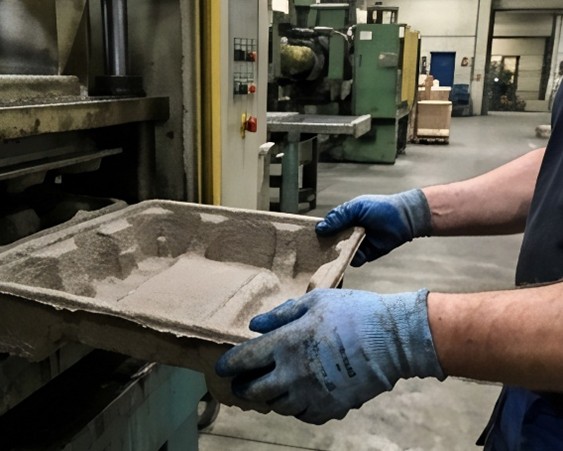
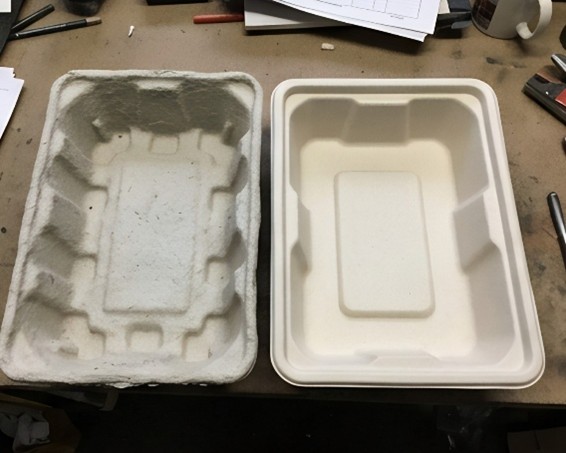
What modern thermoforming and precision tooling have made possible in molded pulp fiber is genuinely different from that reference point. Tight cavity tolerances. Defined surface texture. Embossed geometry. Structural wall profiles that carry real load. The material has not changed in its basic nature, it is still fiber and water and pressure, but what you can do with it has changed considerably.
The brands and industries that discovered this early are now at a different point in the conversation than the ones still catching up. They are not asking whether fiber can do the job. They are asking how to get more out of it.
What precision-formed molded pulp packaging actually does for a product
There is a functional argument and a perceptual argument. They are related but worth separating.
The functional argument is straightforward: a formed cavity holds a product in positive location. It does not shift. It does not require loose fill material stuffed around the product. It is designed for the specific geometry it is protecting, which means it distributes load and absorbs impact according to where the product actually needs protection, not generically. For anything with defined geometry and a surface that cannot be scratched or compressed, this is simply a better solution than foam or generic padding.
The perceptual argument is less talked about in engineering conversations but probably matters more commercially. When someone opens a package and finds a product held in a precisely formed cavity, with no movement, no filler, nothing extraneous, the product feels more considered. The packaging communicates that someone designed it for this specific thing. That signal is worth something. In consumer-facing premium segments it translates directly into brand perception. In B2B contexts it affects how suppliers are evaluated, how products are received on the floor, and occasionally whether a relationship extends or not.
I have seen both of these situations across enough different product categories to believe neither is sector-specific. The dynamic is the same whether you are shipping a precision optical instrument, a high-end bottle of spirits in a gift structure, or a sensitive electronic module to a manufacturing facility. The product deserves packaging that was thought about. When it has that, people notice. When it does not, they notice that too.
Where it gets more complicated
Molded pulp packaging on its own is excellent for most applications in controlled logistics chains. Dry environments, standard temperature ranges, products without extreme structural demands on the packaging itself. Most premium packaging applications fall into this category and unmodified fiber handles them well.
The applications that push outside that envelope are worth being direct about.
Sustained moisture exposure is the most common real limitation. Uncoated fiber absorbs moisture and loses structural integrity. This is simply true. For cold chain applications, outdoor logistics, or products that carry moisture themselves, a barrier coating becomes part of the specification. Water-based coatings, starch-derived barriers, and some plant-based alternatives have been developed specifically to extend moisture resistance while maintaining compatibility with paper fiber recovery. They work. They also add cost and a process step, and recycling compatibility needs to be verified against actual infrastructure in the target market rather than assumed, because this varies more across Europe than most people expect.
Structural load at larger format is the other common constraint. A small insert carrying a light product does not challenge the material much. A large display structure, a multi-unit shipping configuration, or packaging that is expected to stack under significant weight is a different engineering question. In those cases, integrating natural reinforcement, wooden or bamboo elements built into the formed structure, can provide rigidity that fiber wall geometry alone cannot achieve at practical thickness. The material pairing is not elegant in a single-material sense, but both fiber and wood are organic and renewable, and the structural outcome is often better than what you get by over-engineering the fiber alone.
Neither of these situations is a reason to rule out molded fiber. They are reasons to plan around real constraints rather than pretend they do not exist.
The B2B signal that gets ignored
This does not get discussed enough.
Premium packaging conversations almost always focus on the consumer-facing moment. The unboxing. The first impression. The shelf presence. All legitimate. But packaging that moves through B2B supply chains, from supplier to manufacturer, from distributor to installer, is doing the same kind of signaling even when no end consumer ever sees it.
The engineer who receives a component shipment and has to cut through foam and plastic to get to a precision part is having an experience. It is not a brand experience in the consumer sense, but it creates an impression of the supplier that sent it. Packaging that is clean, formed, and obviously designed for the product it contains says something different than generic foam-in-box. In contexts where supplier relationships are evaluated regularly and margins are thin, that difference accumulates.
There is also a procurement dimension that is now increasingly direct. Large manufacturers have sustainability reporting requirements that reach into their supplier base, and packaging is a documented input in many of those assessments. A supplier shipping in fiber rather than foam and plastic is not just making a gesture. They are simplifying the waste management burden at the receiving facility and contributing to the buyer’s own sustainability numbers. That has actual value in tender evaluations, even if it rarely appears on the packaging invoice.
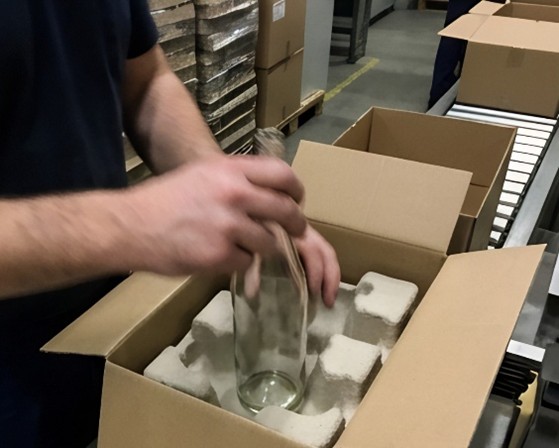
A glass bottle being placed into molded pulp packaging during actual industrial handling.
When to have the conversation
The projects that produce the best outcomes share one characteristic: packaging was part of the product development conversation early, not handed over after everything else was locked.
When a product geometry is finalized before the packaging has been discussed, the packaging engineer works backwards from a fixed brief. They can usually make it work. But there are things that become impossible or expensive at that point that would have been straightforward earlier. Cavity geometry that would have been easy to optimize for tooling is now fixed. A wall profile that would have been designed for structural efficiency is now what it is. The insert that could have been elegant is now adequate.
This is not a packaging-supplier problem. It is an organizational sequencing problem and it happens across industries consistently. Engineering timelines are tight and packaging feels like a downstream detail until suddenly it is a critical path item with a six-week deadline.
The answer is obvious and also apparently hard to implement: bring the packaging conversation in earlier. Not at concept stage necessarily, but before everything else is locked. The return on that timing shift is disproportionate to the effort it requires.

A few questions that come up
Can molded fiber match the tolerance requirements for precision components?
Usually yes, though this is a tooling question more than a material question. Modern thermoformed fiber can achieve cavity tolerances that satisfy most precision instrument, optical, electronic, and medical device packaging requirements. The forming process, wall thickness, and draft angles all affect what is achievable for a specific geometry. For tight requirements the tooling development includes dimensional verification against the actual product. The answer for most applications is yes, provided the timeline allows proper tooling development rather than trying to compress it.
Is it actually more expensive than plastic or foam?
Per unit at comparable volumes, often marginally yes. The gap depends heavily on the application and what you are comparing against. Generic foam is often cheaper. Precision thermoformed plastic is frequently closer to cost parity than clients expect. The comparison also changes when you factor in waste handling costs at the receiving end and sustainability scoring in procurement evaluations, which are increasingly real numbers rather than soft benefits. Nobody asks me whether premium foam is more expensive than basic foam. The cost question only comes up when fiber is on the table, which tells you something about how the calculation tends to get framed.
How does it perform with moisture?
Uncoated fiber absorbs moisture. If the application involves genuine moisture exposure, a coating is part of the specification and that needs to be designed in, not added later. With an appropriate water-based barrier coating, performance extends considerably. The coating adds cost, needs a process step, and requires recycling compatibility to be verified for the specific markets involved.
What happens to it at end of life in an industrial setting?
Uncoated fiber goes into established paper recovery streams across European manufacturing facilities without separation. Coated fiber needs local verification. Hybrid structures with wooden reinforcement need either designed-in separation or a mixed organic stream. In practice all of these are less complicated to manage than the foam and plastic they typically replace. That simplification has real value in facilities that track and report waste, which is most of them now.
Do you need to be involved from the start of product development?
Yes, and I will say it plainly: the best outcomes come from packaging being part of the brief before the product geometry is locked. If we are brought in after everything is fixed we work with what we have, and usually we can make it work. But the projects where we are involved while the product is still being developed produce better inserts, at lower tooling cost, faster. The industry habit of treating packaging as a downstream problem is not serving anyone particularly well.
The packaging is not an afterthought. It is the last engineering decision before the product reaches someone’s hands. Treating it as anything less is a choice, and it is one that tends to show.
If any of this connects to something you are currently specifying, happy to talk through it directly.