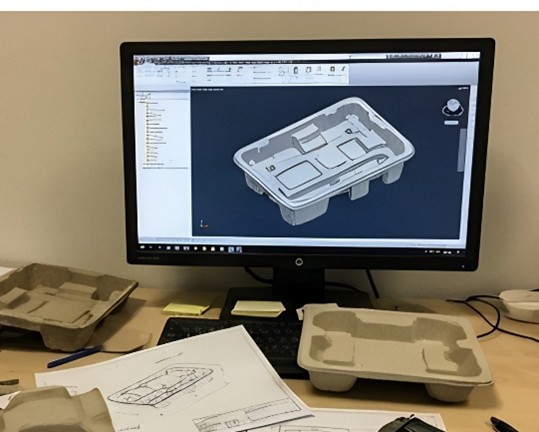
Paper vs Plastic: An Honest Decision
Matrix for Packaging Inserts
Nobody talks about packaging inserts until something breaks. Then everyone has an opinion about the box it came in.
I have spent over two decades in packaging. At Tricor, we work with companies across Europe on protective packaging solutions. And the question I get most often these days is not "what looks good?" It is "what is actually better, pulp or plastic?"
Fair question. Wrong framing.
There is no universally better option. There is only the right option for your specific situation. So let us build the actual matrix, not the marketing version.
The Carbon Footprint Conversation
Expanded polystyrene (EPS, what most people call Styrofoam) is a petroleum-based product. Its production is energy-intensive. According to the European Environment Agency, EPS takes between 400 and 500 years to decompose in a landfill. It does not biodegrade. It fragments into microplastics.
Molded pulp, made from recycled paper or agricultural fibers, is compostable and biodegradable. Multiple life cycle assessment studies, including one published in the Journal of Cleaner Production (Wikstrom et al., 2014), show that molded pulp packaging generates significantly lower greenhouse gas emissions over its full lifecycle compared to EPS.
EPS production requires approximately 3 to 4 MJ of energy per 100g of material. Molded pulp production uses roughly 1.5 to 2.5 MJ per 100g depending on the process and fiber source. The difference compounds across millions of units.
But here is where it gets honest: molded pulp is heavier. Weight means fuel. Fuel means emissions. If your supply chain involves long-haul transport across multiple countries, that weight difference adds up in ways that matter.
The carbon advantage of pulp is real at the production and end-of-life stage. It gets more complicated in the middle. Anyone who tells you otherwise is not accounting for logistics.
Water Usage: The Number People Avoid
This one surprises people.
Pulp manufacturing uses water. A lot of it. The pulping process requires significant volumes to separate and form the fiber. Industry estimates place water usage for molded pulp production at between 10 and 30 liters per kilogram of finished product, depending on the facility and process efficiency.
EPS manufacturing uses far less water in direct production. But that comparison is incomplete without accounting for the water consumed throughout the petroleum extraction and refining process that creates the raw styrene in the first place.
If you evaluate water at the factory gate only, EPS wins. If you evaluate it across the full upstream supply chain, the gap narrows considerably. No source will give you a clean winner here. Anyone who does is selling you something.
Modern pulp facilities increasingly use closed-loop water recycling systems, which bring direct water consumption down significantly. The efficiency gap between a 2010 pulp mill and a 2024 one is substantial. Specifics matter more than averages when you are making a real decision.
Durability: Where EPS Still Holds an Edge
Let us be direct. EPS performs exceptionally well as a protective insert. It absorbs and distributes impact energy efficiently. It is water-resistant. It is dimensionally stable across a wide range of temperatures. For certain product categories, especially fragile electronics and temperature-sensitive goods, EPS has earned its place.
Molded pulp has closed much of that gap. Modern precision-molded pulp inserts can absorb significant shock loads and are designed to perform across standard drop-test conditions. For most consumer goods, the performance difference between a well-designed pulp insert and an EPS equivalent is minimal in controlled testing.
| Performance Factor | Molded Pulp | EPS / Plastic |
|---|---|---|
| Impact absorption (standard) | Good. Meets most drop-test standards. Acceptable |
Excellent. Industry benchmark for fragile goods. Strong |
| Moisture resistance | Limited. Loses integrity in humid conditions. Caution |
Excellent. Fully water-resistant. Strong |
| Temperature stability | Good in standard conditions. Acceptable |
Excellent across extreme ranges. Strong |
| Biodegradability | Fully compostable. Breaks down in weeks. Strong |
400 to 500 years. Microplastic risk. Significant |
| Recyclability | Yes, through standard paper recycling. Strong |
EPS is recyclable but rarely collected. Most goes to landfill. Low in practice |
| Custom shape precision | Very high with proper tooling. Strong |
Very high. Long-established process. Strong |
Molded pulp is vulnerable to moisture. In humid environments or during extended sea freight, this is a real limitation. For high-value fragile goods or refrigerated applications, it needs to be evaluated case by case.
"Good enough" is not a weak conclusion. It is an accurate one for the majority of packaging insert applications.
Logistics Efficiency: The Conversation Nobody Wants to Have
Weight and stackability define logistics efficiency more than material choice.
EPS is extremely light. A standard EPS insert for a consumer electronics box weighs a fraction of the equivalent molded pulp insert. At scale, across thousands of shipments, this weight difference affects freight costs. That is a real number you need to run.
On the other hand, molded pulp inserts often nest and stack more efficiently than EPS counterparts, which are bulky and take up significant warehouse space both before use and after. The void fill ratio of EPS in a warehouse environment is a real cost that often goes unmeasured.
Research from the Packaging Technology and Science journal shows that optimizing insert geometry in molded pulp can offset much of the weight disadvantage through improved pallet density and storage efficiency. The full logistics picture is more balanced than the weight number alone suggests.
One more variable most buyers miss: EPS generates static during handling. For electronic components, that is not a trivial concern. Molded pulp is naturally anti-static. Small detail, real consequence depending on your product category.
The Cost Barrier Is Shrinking
Historically, the main objection to molded pulp was straightforward: it requires a custom mold. That means upfront tooling investment. For a small or mid-sized company, that commitment was often unrealistic.
That barrier is not gone, but it is lower than it was.
Several manufacturers, including at Tricor, now offer standard molded pulp tray systems, corner protectors, and cavity inserts without custom tooling. These off-the-shelf solutions in molded pulp are now price-competitive with EPS equivalents at reasonable order quantities. They give companies access to a credible, compostable solution without the capital commitment of a custom tool.
Molded Pulp: When It Works
EPS: When It Still Makes Sense
This matters for companies currently sitting on the sideline. The entry point has moved. If your reason for not switching is "we cannot afford the mold," that reason is worth revisiting today.
The Full Decision Matrix, Straight
Here is what actually determines which material fits your operation. No winner declared. Just the variables that matter.
| Decision Factor | Choose Molded Pulp | Evaluate EPS or Plastic |
|---|---|---|
| Product fragility | Standard fragility. Meets most drop tests. | Extreme fragility or precision instruments. |
| Moisture exposure | Controlled, dry environment. | Humid climate, open-air, or sea freight. |
| Carbon priority | End-of-life and production emissions in your brief. | Pure transport-weight efficiency is the only metric. |
| Volume and budget | Standard options available at low volume. Custom at high volume. | Ultra-low unit cost is the sole constraint. |
| Warehouse space | Better pallet density and nesting. | EPS is bulkier; storage cost is higher. |
| End-of-life | Compostable, biodegradable, paper-recyclable. | EPS rarely recycled in practice. Long landfill life. |
| Brand perception | Communicates a genuine product choice to the customer. | Neutral or negative in many consumer categories. |
| Regulatory direction | Aligned with EU Single-Use Plastics Directive trend. | Increasing regulatory pressure in multiple markets. |
The question is not which material is better. The question is which material fits your product, your route, your customer, and your constraints. Molded pulp is not a perfect solution. But for a large share of packaging insert applications, it performs well enough, costs competitively, and carries a significantly cleaner end-of-life story. Choosing EPS because it is familiar is no longer a neutral decision. Neither is choosing pulp because it sounds better. Make the choice with data, not with momentum.
Frequently Asked Questions
Molded Pulp Packaging InsertsMolded pulp packaging is a protective material made from recycled paper fibers or agricultural byproducts such as sugarcane bagasse or wheat straw. The pulp is formed into custom or standard shapes using molds and dried under heat and pressure. The result is a rigid, biodegradable insert designed to cushion and protect products during shipping and handling. It is used as an alternative to EPS foam and plastic inserts across a wide range of industries.
Custom molded pulp requires upfront tooling investment, which historically made it more expensive at low volumes. However, standard off-the-shelf molded pulp trays and inserts are now price-competitive with EPS equivalents at modest order quantities. Total cost comparison should always include freight weight, storage space, and disposal costs, not just unit price. When those factors are included, the gap narrows considerably for many applications.
No. Molded pulp performs well for most standard consumer goods and e-commerce applications. For highly fragile electronics, temperature-sensitive products, or environments with significant moisture exposure, EPS still holds performance advantages that are difficult to match with pulp alone. Molded pulp is the right choice for a large share of packaging insert applications. That share is growing. But it is not every application, and claiming otherwise does not help anyone make a good decision.
This is a genuine limitation worth taking seriously. Molded pulp absorbs moisture and can lose structural integrity in humid environments or during extended sea freight without additional protective measures. Coated or wax-treated molded pulp variants offer improved moisture resistance, but they also reduce compostability. If your shipping route includes high-humidity exposure or extended ocean transit, evaluate this carefully before committing. The right choice depends on your specific conditions, not on general product claims.
Not anymore. Several manufacturers now offer standard molded pulp solutions including corner protectors, cavity trays, and end caps that require no custom tooling. These are a practical entry point for companies that want to move away from EPS without committing to a custom development project or upfront tooling cost. At Tricor, we work with both standard and custom solutions depending on volume, product geometry, and budget. The conversation starts earlier than most companies expect.
Yes, uncoated molded pulp made from natural fibers is compostable and biodegradable. It breaks down within weeks in a composting environment and can also be recycled through standard paper collection streams. Coated variants may have longer breakdown times and should be checked against local composting standards before making claims to customers. In contrast, EPS (Styrofoam) takes an estimated 400 to 500 years to decompose and breaks down into microplastics in the process. The end-of-life difference between the two materials is not marginal. It is significant.
EPS is lighter, which reduces per-shipment freight weight. That is a real cost factor at high volumes over long distances. However, EPS takes up significantly more warehouse space due to its bulk. Molded pulp inserts often nest and stack more efficiently, improving pallet density and reducing storage costs. The net logistics impact depends on your shipping distances, volumes, and warehouse constraints. Neither material wins on every logistics variable. The honest answer is: run the numbers for your specific operation.
Consumer electronics at standard fragility levels, cosmetics, glass bottles and jars, household appliances, tools, and food products are all strong candidates. Products with heavy glass components, wine bottles, and retail items that need a premium unboxing experience are particularly well-served by molded pulp. Products requiring extreme shock absorption (such as precision instruments or high-drop-height applications) benefit from case-by-case evaluation before switching from EPS. When in doubt, drop testing tells you more than a specification sheet.
Yes, and the pressure is increasing. The EU Single-Use Plastics Directive and the ongoing revisions to the EU Packaging and Packaging Waste Regulation are both moving in a direction that creates growing compliance risk for EPS. Several EU member states have already introduced or announced restrictions on specific EPS packaging applications. Companies that start the evaluation process now are in a significantly better position than those who wait for a regulatory deadline to force the decision. Proactive evaluation is cheaper than reactive scrambling.