A word from our CEO Matjaž Bergant
There are two completely different markets inside molded pulp
Most of the industry attention, the trade show presentations, the supplier brochures, goes toward custom-designed molded fibre. A tray shaped precisely around your product. Branded. Engineered to your dimensions. It is genuinely impressive work, and for the right company at the right volume, it sure makes complete sense.
But sitting alongside that, too often forgotten about and ignored in supplier conversations, is an entire category of standard molded pulp products. Pallets. Corner protectors. Protective pads that come in sheets. Products that have been manufactured in enormous quantities, sitting in warehouses, available to order like any other stock item.
No tooling invoice. No six-month development process. No minimum annual volume discussion.
I don’t know why this part of the market doesn’t get talked about more, except that standard products carry lower margins for suppliers and generate less interesting conversations. Yes, custom is sexier to sell. But if you’re a small company trying to actually move a project forward, standard is often the only door that’s actually open.
There are two completely different markets inside molded pulp
Most of the industry attention, the trade show presentations, the supplier brochures, goes toward custom-designed molded fibre. A tray shaped precisely around your product. Branded. Engineered to your dimensions. It is genuinely impressive work, and for the right company at the right volume, it sure makes complete sense.
But sitting alongside that, too often forgotten about and ignored in supplier conversations, is an entire category of standard molded pulp products. Pallets. Corner protectors. Protective pads that come in sheets. Products that have been manufactured in enormous quantities, sitting in warehouses, available to order like any other stock item.
No tooling invoice. No six-month development process. No minimum annual volume discussion.
I don’t know why this part of the market doesn’t get talked about more, except that standard products carry lower margins for suppliers and generate less interesting conversations. Yes, custom is sexier to sell. But if you’re a small company trying to actually move a project forward, standard is often the only door that’s actually open.
What you can get today, without any development cost
Molded pulp pallets
These are one I come back to repeatedly. A standard wooden pallet runs 20 to 25 kilograms. A molded fibre pallet in the same footprint sits between 6 and 12 kilograms depending on grade. On air freight, that weight difference costs real money per shipment, every shipment.
Beyond weight, there’s the ISPM 15 issue. Wooden pallets moving across certain borders require phytosanitary treatment, which adds cost and documentation overhead. Molded pulp doesn’t. For export-heavy companies, this alone sometimes justifies the switch.
A company we work with has adopted molded pulp pallets purely on logistics cost grounds, with sustainability as a secondary benefit. That’s fine. The outcome is the same. And, they are available in half pallet sizes also.
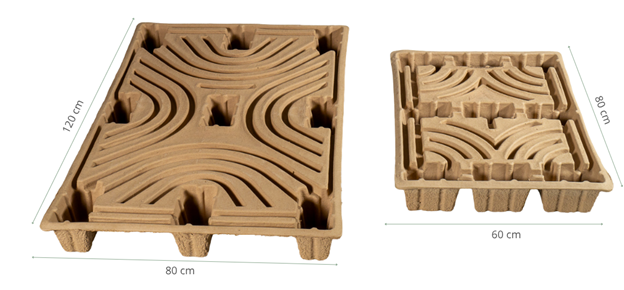
Molded pulp pallets in standard EUR and half-EUR sizes
Corner protectors
THIS is where I’d tell most small companies to start. Molded pulp corner protectors exist in standard profiles covering the most common board thicknesses and product dimensions. They replace plastic or EPS corner guards in transit packaging. The protective performance, for most standard transit conditions, is comparable.
The switch itself isn’t complicated. You’re not redesigning your packaging. You’re swapping one component you’re already buying. The molded pulp version comes from stock. You test it. If it passes, you update your specification and you’re done.
We are working currently with a smaller furniture company, family business. They had been using plastic corner guards on their transit packaging for years. They wanted to remove plastic but had no budget for development. We swapped the corners to a standard molded pulp profile that was close enough dimensionally, ran a basic drop test, and they were done within a month. No tooling. No supplier negotiation about volume. They order what they need when they needed it.

Eco-friendly molded pulp corner protection made from recycled materials
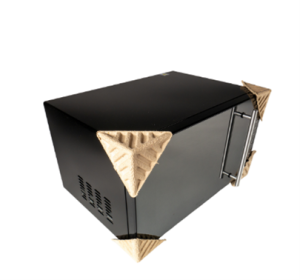
Eco-friendly molded pulp edge protectors for safe transport and storage
That’s the model.
Sheet protective pads PulpSafe
Molded pulp pads get used between stacked products, to wrap ceramics, between automotive parts, inside cases with glass components. They come in standard sizes, and some suppliers will cut to size at relatively small quantities without treating it as a custom development job.
If you’re currently using foam sheeting or plastic bags as void fill or surface protection between products, PulpSafe is often a direct replacement. Same functional category. Different material. Available from stock.
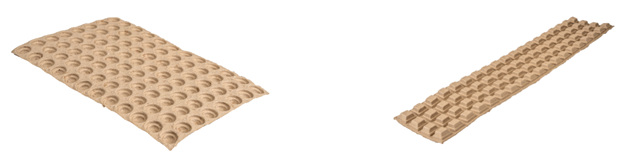
PulpSafe ProPlus pads: durable, eco-friendly molded pulp protection
Let me walk through how we do this for with smaller companes
Say you run a small operation producing premium olive oil, bottled in glass. You ship cases across Europe with foam inserts between bottles to stop the glass knocking together in transit. The foam works fine. It also arrives at every wholesaler and restaurant looking like something that belongs in a skip.
You call a custom moulded pulp supplier. They ask about annual volume. You give them your numbers. They start explaining tooling costs and minimum order requirements, and within about four minutes you understand this conversation isn’t going anywhere useful.
The standard route looks different.
You find a moulded pulp sheet pad in a size that fits your case footprint. You order a few hundred as a trial. You pack a case the same way you always do, with Pulp protect wreapped around bottles instead of foam, put it through your normal handling, check the glass on arrival. If nothing breaks and nothing shifts, you update your spec and you’re done.
Total cost of the trial: negligible. Total elapsed time: two to three weeks. No tooling charge on any invoice, no volume commitment, no six-week sampling process.
It’s not complicated. It just requires knowing the standard product exists and tracking down a supplier who stocks it.
You wonder why this path doesn’t get suggested more often?
Custom packaging has better stories. A CEO will put a custom-formed molded pulp tray in front of investors and say “we redesigned our packaging around sustainable materials.” That’s a slide. That’s a press release.
A standard molded pulp corner protector replacing a plastic one doesn’t make the investor deck.
But I have seen too small companies burn six months and real money chasing custom molded pulp projects that were just not viable at their volume, when a standard product would have solved 80% of their problem in three weeks. The best packaging decision isn’t always the most interesting one.
There’s also a supplier incentive issue worth naming directly. Custom packaging development locks a client in. Standard product doesn’t. So commercial conversations tend to drift toward custom even when standard is the more sensible recommendation.
When does custom actually make more sense?
When you’re above 300.000 to 500.000 units annually for a specific format, and when standard dimensions genuinely can’t meet your product requirements, custom development conversation makes sense. At that volume, tooling costs amortise into unit pricing at levels that also make sense. Below it, currently you’re might be fighting economics that won’t cooperate.
There are cases of clients who grew into custom. They started with standard corner protectors on their transit packaging, built volume, hit a point where a custom inner tray made commercial sense, and developed it properly. That’s a sensible progression. Trying to skip to the end before the volume is there is where projects die.
A few direct questions worth answering.
Look at your current packaging. Where are the plastic or EPS components that exist specifically to protect the product in transit? Corner guards, separators, end caps, pads? Are any of those a standard shape?
If yes, there is probably a molded pulp equivalent available from stock in Europe today. The question is whether you’ve looked for it.
My advice?
Start with what exists. Test it. If it works, ship it. The path to more sophisticated molded pulp packaging is built on that foundation, not on a EUR 20,000 tooling invoice you can’t justify.
FAQ
Can I really buy molded pulp packaging without any tooling investment?
Yes, for standard products. Molded pulp pallets, corner protectors, sheet pads, and end caps are available from as catalogue items. No tooling charge, no development cost. You order what you need.
What are realistic minimum order quantities for standard molded pulp?
Typically one pallet of stock, somewhere between 200 and 1,000 units depending on the product format. This is completely different from custom molded pulp, where annual volume requirements in the hundreds of thousands are standard.
Are molded pulp corner protectors actually protective enough?
For most standard transit conditions, yes. The honest answer is that you should run a basic validation test before switching at scale, but standard molded pulp corner profiles perform well under compression and impact within normal packaging test parameters. Most suppliers have performance data for their standard profiles.
What about molded pulp pallets for heavy products?
Molded fibre pallets have specific load ratings and are not designed for heavy dynamic racking. They work well in one-way export, air freight, and restricted-wood environments. Check the load specification against your application before ordering. Within their rated capacity they perform reliably.
When should I consider moving to custom molded pulp?
When you’re consistently above 300.000 to 500.000 units annually for a specific format and standard dimensions aren’t meeting your product requirements, the custom conversation becomes viable. Below that threshold, standard products are almost always the better commercial and practical choice.